Stay In Touch
this is blank
except for this
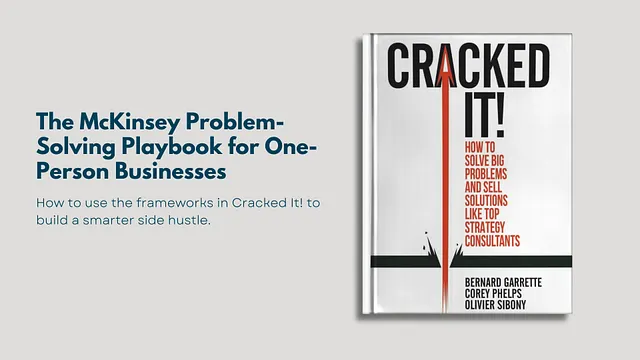
I spent ten years in the corporate trenches, watching high-priced consultants charge my bosses $200,000 just to tell us what we already knew. I thought they were geniuses — until I realized they weren’t smarter than us; they just had a better system for thinking.
Now that I’m building my own business, I don’t have a $200k budget to hire McKinsey. Neither do you.
But after reading Cracked It! by Bernard Garrette, Corey Phelps, and Olivier Sibony, I realized we can steal their entire playbook for the price of a paperback and use it to scale our own “one-person” empires.
Most creators fail because they solve the wrong problems. They work 14-hour days on the “solution” before they even understand the “trouble.” Let’s fix that right now.
1. Master the 4S Method to Stop Playing Guessing Games
“A disciplined, general-purpose problem-solving method is the ultimate meta-skill for the 21st-century entrepreneur.”
If you’re winging it, you’re losing. Most solopreneurs wake up, look at a problem — like low sales — and immediately try to “fix” it by changing their Twitter bio or buying a new tool.
That is jumping to conclusions. The 4S Method (State, Structure, Solve, and Sell) forces you to slow down so you can actually move faster later.
State the problem clearly first. Don’t assume you know what’s wrong. Use a formal framework to ensure you aren’t just chasing shadows.
Structure the problem by breaking it into smaller pieces. You can’t fix “low revenue,” but you can fix a “2% checkout abandonment rate.”
Solve the problem by doing the actual work or analysis. This is where the magic happens. Use data, not just “vibes,” to find your answer.
Sell the solution. Whether you’re selling to a client or just convincing yourself to pivot, you need a compelling narrative to make it stick.
Stop treating your business like a series of fires to be put out. Treat it like a system to be engineered.
2. Escape the “Othello Trap” of Emotional Decision-Making
“Humans default to ‘System 1’ thinking — an automatic, intuitive mode that relies on limited information to create a plausible story.”
We’ve all been Othello. We see one piece of “evidence” — a negative comment or a slow launch day — and we build a whole story about how our business is failing.
This is the Othello Trap. Your brain loves to jump to conclusions because it’s energy-efficient. It wants a story, not the truth.
As a solopreneur, your “gut feeling” is often just your anxiety in a trench coat. To build a real business, you must engage System 2 thinking: slow, effortful, and logical.
Avoid the “Expertise Trap.” Just because you were a killer project manager at your 9–5 doesn’t mean you automatically know how to run a newsletter.
Beware of analogies. Don’t assume a strategy that worked for Apple or some “Alpha” guru on X will work for your specific context.
Look for the “unknown unknowns.” Remind yourself that “What You See Is All There Is” (WYSIATI) is a fallacy that keeps you small.
Level up your awareness. When you feel that urge to burn it all down and start a new niche, pause. That’s your System 1 talking. Demand the data.
3. Use TOSCA to Define the Problem Before You Spend a Dime
“A problem well-posed is half-solved; most failures stem from a flawed initial definition.”
I once spent three weeks building an automated email sequence for a product that didn’t have a traffic problem — it had a trust problem. I solved the wrong issue.
The TOSCA framework prevents this waste of life. Before you start “solving,” answer these five questions:
- Trouble: What is the specific symptom or gap between where you are and where you want to be?
- Owner: Who has the power to make the final decision? (Usually you, but acknowledge the role).
- Success Criteria: What does a “win” look like in measurable terms? (e.g., “Restore 5% revenue growth”).
- Constraints: What are the limits? (Budget, time, tech stacks, or legal hurdles).
- Actors: Who are the stakeholders who can influence the outcome or are affected by it?
Write your TOSCA statement down. Put it where you can see it.
If you can’t define the “Trouble” in one sentence, you don’t understand it yet. Don’t start building until the “Success Criteria” are measurable.
Vague goals lead to vague results. Get surgical.
4. Break It Down with MECE Issue Trees
“Decompose the core question into a set of smaller, MECE sub-questions to maintain an exploratory mindset.”
Complex problems are like giant tangled balls of yarn. You can’t pull one string and hope for the best; you’ll just tighten the knot.
You need an Issue Tree. Start with your core question: “How do I make $10k/month as a creator?”
Now, apply the MECE principle: Mutually Exclusive, Collectively Exhaustive. This means your categories shouldn’t overlap, and they should cover every possibility.
- Mutually Exclusive: Your branches shouldn’t double-count issues.
- Collectively Exhaustive: You haven’t left any logical stones unturned.
To make more money, you only have two levers: increase the number of customers OR increase the average order value.
Continue branching until the questions are specific enough to be answered with a simple “yes” or “no” based on data.
When you see your business as a tree, you stop guessing. You realize you don’t need “more followers” — you need to fix the specific branch that’s broken.
5. Adopt Design Thinking for Human-Centered Challenges
“When a problem is ill-defined and centered on human behavior, traditional logical analysis often fails.”
Logic works for spreadsheets. Empathy works for customers.
If you’re launching a digital product and no one is buying, an issue tree might show you that the conversion rate is low. But it won’t tell you why they don’t trust you.
This is where you switch to Design Thinking. You need to empathize with your “Extreme Users.”
Observe people in the wild. See how they actually use your product, not how you hope they use it.
Use Journey Maps. Visualize the user’s experience step-by-step to identify specific “pain points.”
Prototype early and cheaply. Use “rough and fast” models — a simple landing page or a Google Doc — to gather feedback before over-investing.
Test to be wrong. Seek disconfirming evidence during user testing rather than looking for praise.
6. Communicate Your Value with the Pyramid Principle
“Decision-makers do not want to hear about your analytical struggles; they want the answer first.”
When you’re writing a sales page, a cold email, or a LinkedIn post, stop telling people your life story. Nobody cares about your “journey” until they know what’s in it for them.
Use Barbara Minto’s Pyramid Principle. Lead with the answer.
Most professionals communicate chronologically, which is a death sentence for attention. Instead:
- The Key Line: State your main recommendation or value prop immediately.
- The Support: Provide 3–5 logical arguments that prove your recommendation is correct.
- The Data: Provide the evidence only when the reader is already hooked.
Use the SCR Framework for your intros: Situation, Complication, Resolution.
Use Action Titles. Instead of a heading called “Marketing Results,” call it “Instagram Ads Reduced Lead Cost by 40%.”
Be direct. Be punchy. Don’t bury the lead.
7. Never Rely Solely on “Givens” or Internal Plans
“Analysis is not just about crunching numbers… Be especially careful; a correlation does not imply causation.”
I once thought my Twitter growth was driving my newsletter signups. I spent all my time on X.
When I actually looked at the data, the growth was coming from a guest post I wrote months ago. The Twitter growth was a spurious correlation.
Check for “Survivor Bias.” Don’t just look at the one creator who made $1M on TikTok and assume that’s the blueprint.
Make assumptions explicit. Document every guess you make so that its impact can be tested later.
Perform sensitivity analysis. Check if your business still works if your most important assumption (like conversion rate) is off by 20%.
Rigorous thinking is the difference between a “side hustle” and a “sustainable business.” Get your bag, but get it logically.
The problem-solving frameworks I’ve shared here — like the 4S Method and the Othello Trap — are straight from the book Cracked It! by Bernard Garrette, Corey Phelps, and Olivier Sibony. If you want a deeper dive into these McKinsey-level strategies, I’ve put together a detailed summary of the book on my Substack newsletter. I break down the best business books so you can build your one-person business faster.
The Final Word: From Analysis to Action
You now have the playbook. You have the 4S method, the TOSCA framework, and the Pyramid Principle.
But knowledge without action is just “procrastination in a suit.” Don’t become the “Hamlet” of solopreneurs, stuck in endless analysis paralysis.
The “Goldilocks Rule” of problem-solving is finding the balance. Be thorough enough to avoid the Othello Trap (acting too fast), but fast enough to avoid the Hamlet Trap (acting too slow).
Here is your 10-minute exercise for today:
Take the biggest bottleneck you are currently facing in your business. Grab a piece of paper and run it through the TOSCA framework.
- Trouble: What is the specific symptom?
- Owner: Confirm you are the decision-maker.
- Success Criteria: What is the hard number you want to hit?
- Constraints: What are your non-negotiables?
- Actors: Who do you need to influence?
Once you define it, the solution usually presents itself.
So, let me ask you: What’s the one problem you’ve been “thinking” about for weeks that you’re finally going to define today?
Stop guessing. Start cracking it.
Responses (8)
Minkari she/her
What are your thoughts?
Great article and very helpful

I worked for McKinsey for 5 years and use all the frameworks mentioned. I scaled a software company from 8 to 800 people and increased its value from $7 million to $7.5 billion.

Take a look at my Sales Tales
35
That is jumping to conclusions. The 4S Method (State, Structure, Solve, and Sell) forces you to slow down so you can actually move faster later.
I know a few people who could benefit from this type of system.
20
In addition to the methods described, Mckinsey and others collect plenty input from the client. They use this often to reflect back, mirror words and phrases and ultimate sell the solution that works for the client. It might not be the best solution…
23
More from Zack Liu
Recommended from Medium
[
See more recommendations